Vickers Hardness Testing:
The Guide to the Vickers Hardness Test
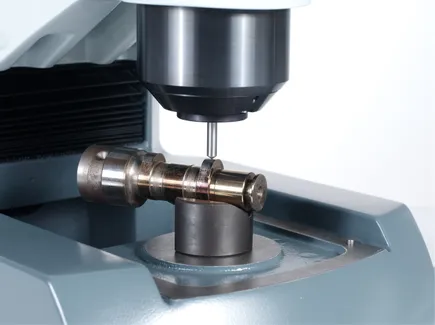
According to ISO 6507 and ASTM E384: Procedure, calculation and application of the Vickers method for all metallic materials.The Vickers hardness test is a universal, optical testing method for determining the Vickers hardness (HV) of almost all metals and materials. Standardised according to ISO 6507 and ASTM E384, the method uses a 136° diamond pyramid as an indenter to deliver precise results in the micro to macro load range. Despite the effort involved in sample preparation, the method is considered the international standard in materials testing. To perform this test with high accuracy and reproducibility, a specialized vickers hardness tester is required.
Which Vickers methods and applications are there?
The Vickers hardness test is divided into three load ranges according to ISO 6507: micro hardness (< 0.2 kgf), small load (0.2 to < 5 kgf), and the macro range ($\ge$ 5 kgf). The applied test force in Newtons is decisive – typical designations are HV 0.1, HV 1, or HV 10. Depending on the load range, the spectrum of applications also varies: while micro hardness testing is suitable for thin layers or case depth (EHT), higher forces are used for solid components and weld seams. Each Vickers method thus enables targeted adaptation to the respective testing objective.
| Load range | Method | Penetrating body | Test force F [N] | Applications | Validity |
|---|---|---|---|---|---|
| Microhardness range | HV 0,01 HV 0,025 HV 0,05 HV 0,1 | Diamond pyramid 136° | 0,098 N 0,245 N 0,490 N 0,980 N | Structural components very thin layers | Area 1 HV - 3.000 HV* |
| Small power range | HV 0,2 HV 0,3 HV 0,5 HV 1 HV 2 HV 3 | Diamond pyramid136° | 1,961 N 2,942 N 4,903 N 9,807 N 19,61 N 29,42 N | Thin layers Eht/Rht/Nht series Thin sheets Small components | |
| Macro range (Conventional hardness range) | HV 5 HV 10 HV 20 HV 30 HV 50 HV 100 | Diamond pyramid136° | 49,03 N 98,07 N 196,1 N 294,2 N 490,3 N 980,7 N | Standard components |
*Recommended hardness range according to ISO 6507
Documentation of results
Standard-compliant documentation is essential for quality assurance. Learn how to correctly report values according to ISO 6507 here:
Factors for choosing the right Vickers method
To obtain a standard-compliant and exact measurement result according to ISO 6507, the following criteria should be considered when selecting the test force:
- Minimum specimen thickness: The specimen must be at least 1.5 times the indentation diagonal. Common minimum thicknesses range between 0.085 mm and 6.5 mm depending on the load range.
- Indentation and edge distances: To avoid measurement errors caused by work hardening, the minimum distances between test points and to the specimen edge as defined in the standard must be strictly observed.
- Surface quality: Since Vickers indentations (especially in the micro and low-load range) are very small, a polished or ground surface is essential. Any surface irregularity can distort the optical evaluation of the result.
- The "Golden Rule": Always measure with the highest possible test force. The larger the indentation, the smaller the relative influence of surface imperfections on the final hardness value.
Maximum precision from micro to macro load ranges
Suitable Vickers hardness testers for your application
DuraScan G5 Series
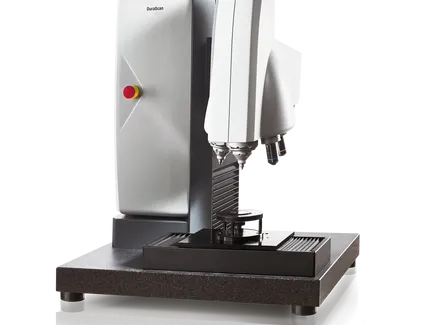
Specialised in the micro and small force range (HV 0.00025 to HV 62.5). This system is the ideal solution for precise EHT profile measurements and the analysis of thin layers and minute structural components.
DuraVision G5 Series
The robust universal genius for the macro load range (HV 1 to HV 250 / HV 3000). The series is optimised for testing large, heavy components and for highly automated series testing in production.
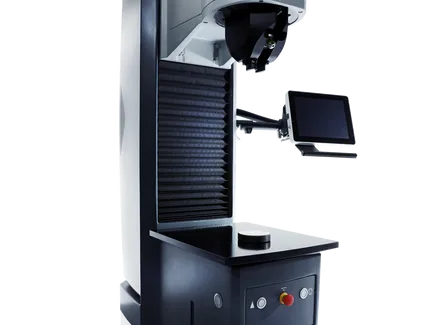
DuraVision Hardness testing machine
What is the procedure for the Vickers hardness test?
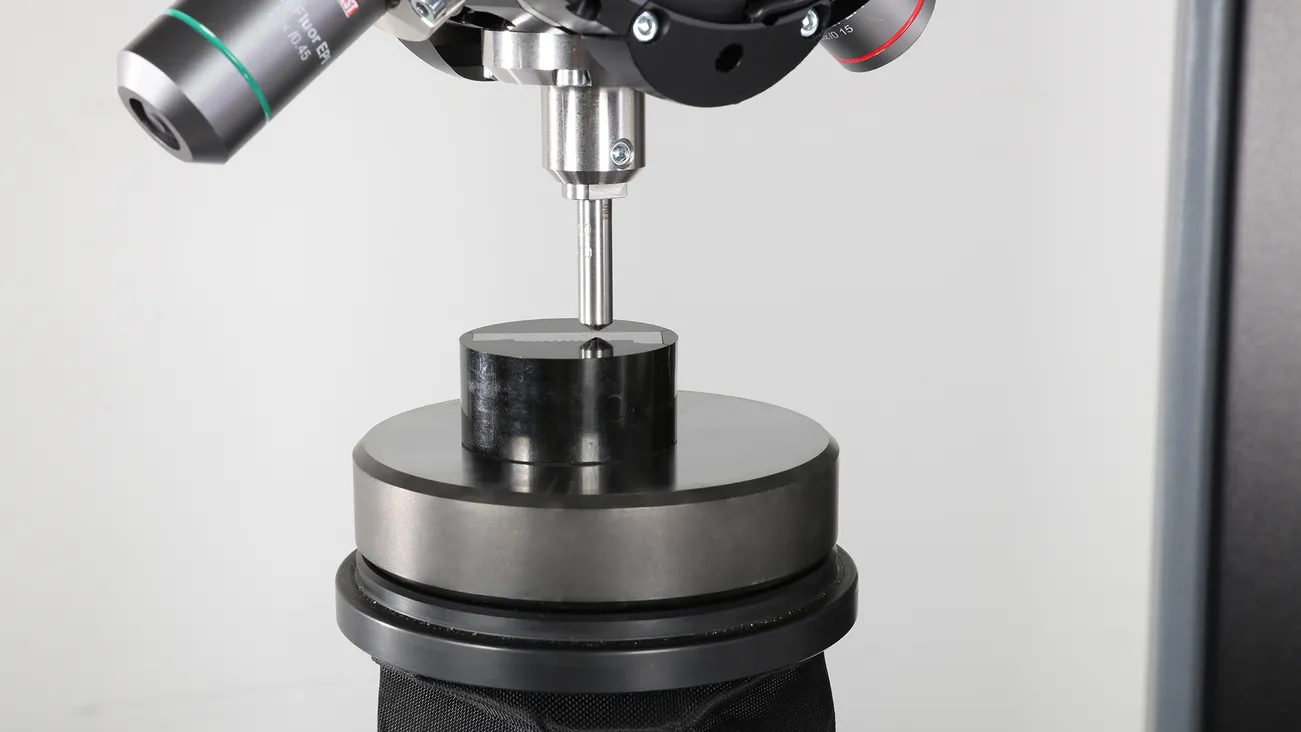
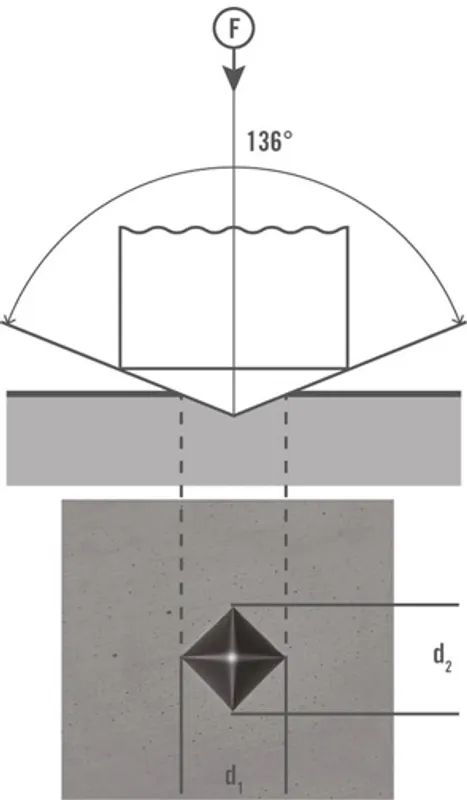
The Vickers hardness test is an optical measuring method in which the hardness is determined by the size of the permanent indentation. A diamond-shaped indenter is pressed into the surface of the test specimen with a defined force. After the load is removed, the indentation diagonals are measured. In contrast to methods such as Rockwell, where the depth of the indentation is decisive, the Vickers method is based on a geometric evaluation of the diagonals. A larger indentation indicates a lower Vickers hardness of the material.
How is Vickers hardness calculated?
The Vickers hardness (HV) is determined by dividing the applied test force (in Newtons) by the surface area of the permanent indentation in the material. The indentation is made with a pyramid-shaped diamond with an apex angle of 136°. The mean value of the two diagonals of the square indentation is used to calculate the indentation surface, as this is often slightly distorted in practice.
The calculation is carried out in accordance with ISO 6507 or ASTM E384. The typical measuring range extends from around 1 HV to 3000 HV - depending on the material and test load.
Vickers Hardness Test: Advantages and Disadvantages
The Vickers method has the following advantages:
- The Vickers hardness test is suitable for almost all materials - from very soft to extremely hard materials - and therefore covers the entire hardness range.
- The same pyramid-shaped diamond is always used as the indenter, regardless of the Vickers method selected. This also eliminates the need to retool the indenter.
- As the indentation is small, the test can be considered virtually non-destructive in many cases - the test piece can usually be reused.
The Vickers method has the following disadvantages:
- The surface quality of the specimen must be good, because the indent is measured optically. This means that the test location must be prepared (ground and polished), otherwise precise evaluation is difficult.
- The process is rather slow (compared with the Rockwell method). The test cycle takes somewhere between 30 and 60 seconds, not including the time taken to prepare the specimen.
- Due to the need to conduct optical indent evaluation, Vickers hardness testers must be equipped with an optical system, which makes them more expensive to purchase than Rockwell testers.