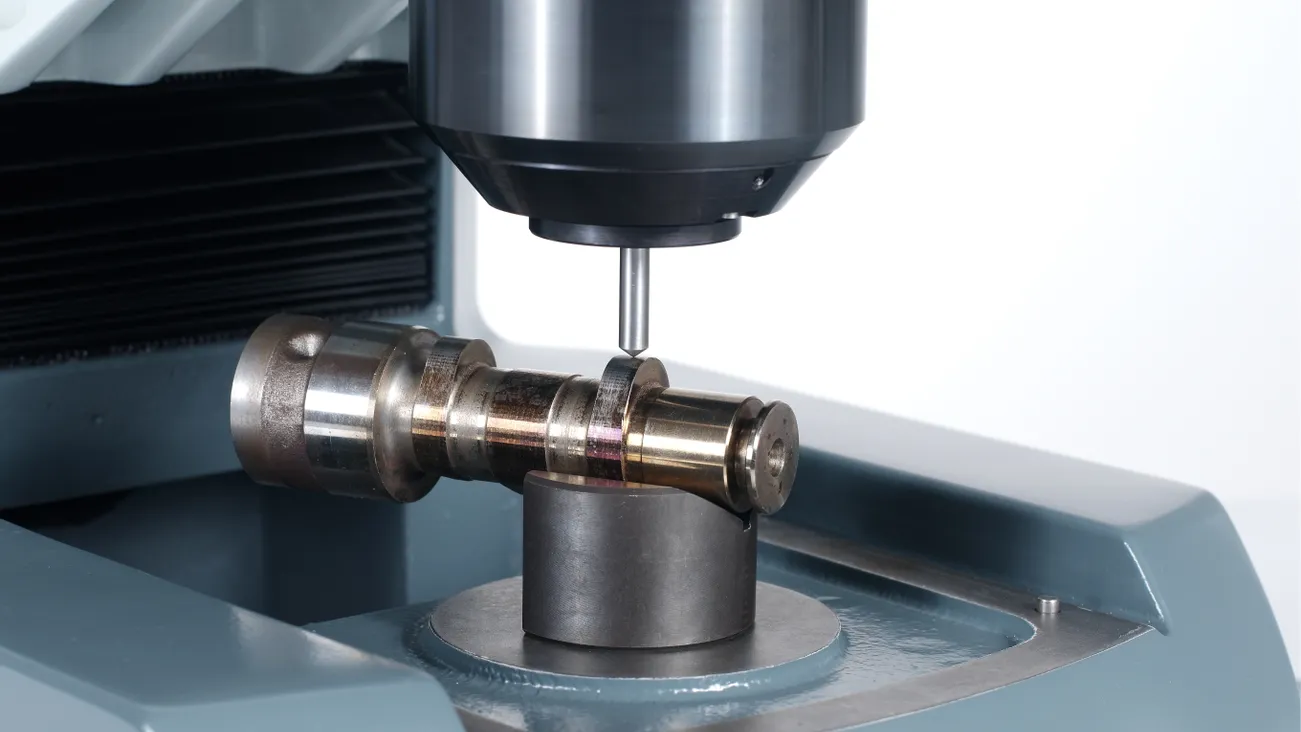
Rockwell hardness test
ISO 6508 and ASTM E18
Procedure, scales and application of the depth difference method for metallic materialsRockwell hardness test procedure:
Determination of Rockwell hardness HR
The Rockwell hardness test is a globally standardised depth difference method (ISO 6508 / ASTM E18) for determining the hardness of metallic materials. In contrast to optical methods such as Brinell, Vickers or Knoop, the Rockwell hardness test measures the permanent indentation depth of a test specimen.
The principle of Rockwell hardness is simple: the deeper the indenter penetrates the workpiece surface at a constant test force, the lower the material hardness. The hardness value (HR) is calculated directly from this measured difference. Due to its speed and automatability, this Rockwell hardness testing method is one of the most efficient methods in modern quality assurance.
Rockwell Hardness Testing Procedure
according to DIN EN ISO 6508-1
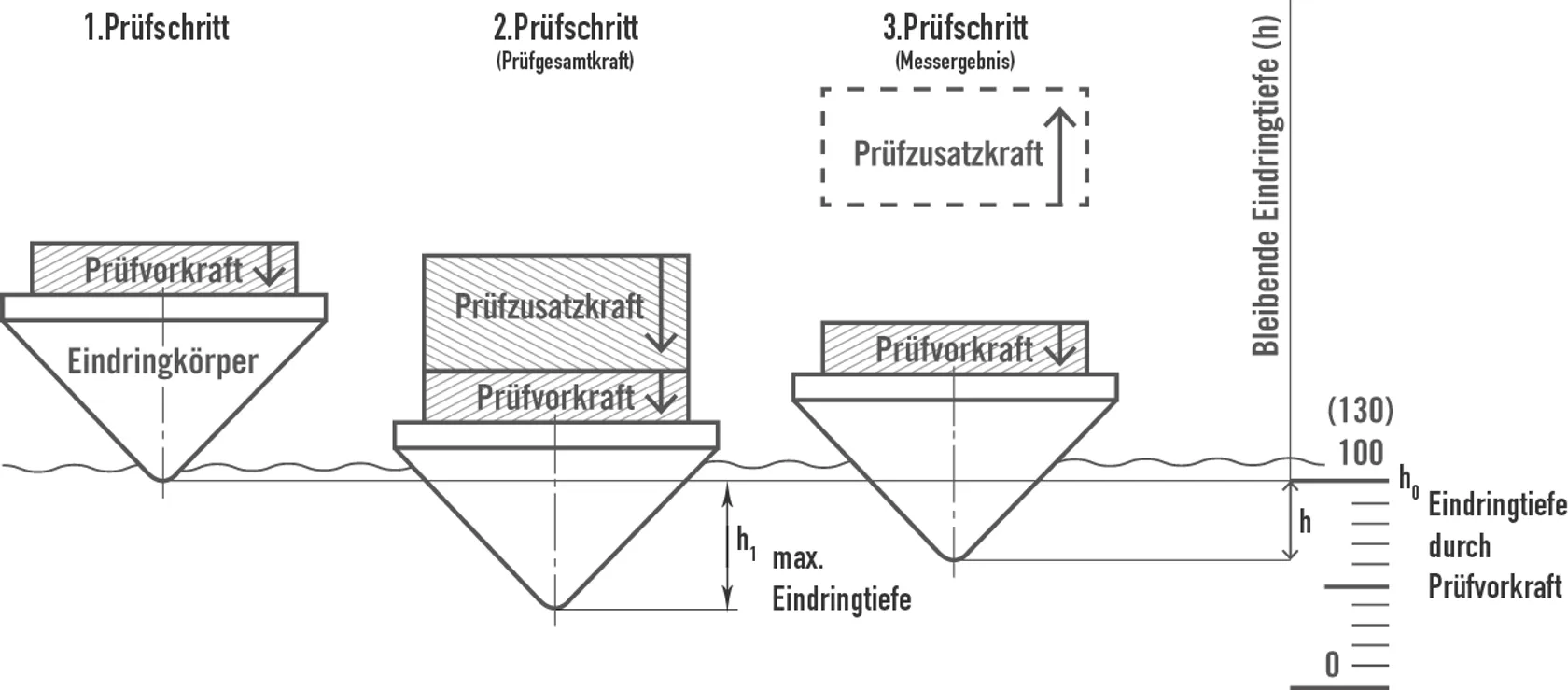
The depth-difference method operates in two stages to mathematically eliminate surface roughness and elastic deflections of the testing machine:
- Establish the Reference Datum (Preliminary Test Force F0):
The indenter is applied backlash-free with the preliminary force (10 kgf for regular Rockwell, 3 kgf for Superficial Rockwell). The indentation depth is zeroed to the reference baseline (t0 / h0). - Apply Main Test Force (Additional Force F1):
The additional test force is applied smoothly without shock, bringing the system to the total test force (F = F0 + F1). Once reached, this load is held for the norm-defined dwell time (typically 2 to 6 seconds). The material undergoes plastic flow. - Measure Depth Difference & Release to F0:
The additional force F1 is removed while the preliminary force F0 is maintained to keep the machine seated. The purely elastic portion of the deformation recovers, and the measuring system precisely records the permanent plastic indentation depth h.
Rockwell Hardness Calculation Formula
From the measured permanent indentation depth h in millimetres, the testing software calculates the hardness value according to the standard formula:
HR = N - (h / S)
- N (Scale Constant): 100 for diamond cone scales (e.g. HRA, HRC, HRD) or 130 for ball scales (e.g. HRB, HRF, HRG).
- S (Scale Division): 0.002 mm for regular Rockwell or 0.001 mm for Superficial Rockwell.
- h: Permanent indentation depth in millimetres.
Example HRC: For a permanent indentation depth of h = 0.08 mm:
HR = 100 - (0.08 / 0.002) = 100 - 40 = 60 HRC
Normative Minimum Spacings according to ISO 6508
To prevent measurement errors caused by work hardening from adjacent test indents:
- Distance between two indentations: at least 3 × mean indent diameter (or at least 3 mm).
- Distance from center of indent to specimen edge: at least 2.5 × indent diameter (or at least 2.5 mm).
Maximum efficiency through fast depth difference measurement
The right Rockwell hardness tester for your application
DuraJet G5 Series
Specialised in the Rockwell range and plastics testing (9.8 N to 2450 N). This system is the ideal solution for rapid series testing directly in production and precise measurements on components with minimal sample preparation.
DuraVision G5 Serie
Das robuste Universalgenie für den Makrolastbereich (3 kgf bis 3000 kgf). Die Serie ist für die Prüfung großer, schwerer Bauteile sowie für hochautomatisierte Rockwell-Prüfaufgaben im Labor und in der Fertigung optimiert.
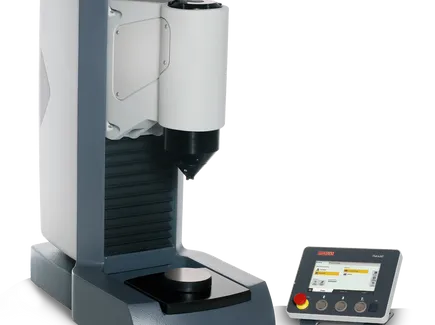
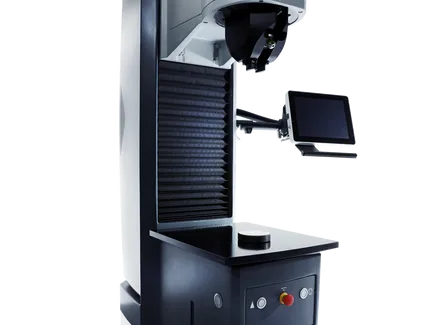
DuraJet G5 Hardness tester
Important features and standards of Rockwell hardness testing
Rockwell hardness testing is defined as a static hardness testing method and can be characterised by specific technical parameters. Compared to other methods in the macro range, it is distinguished by the following features:
- Global standardisation: The method complies with the international standards ISO 6508 and ASTM E18.
- Test force range: The method is used to test hardness in the macro range (test force >= 49.03 N) with a test force of 29.42 N to 1471 N.
- Measuring principle: As a classic depth difference method, Rockwell hardness is not determined optically, but rather by the permanent indentation depth created by the indenter.
- Shape and material of the indenter: Depending on the Rockwell method, a diamond cone (120°) or carbide balls are used.
Rockwell vs. Super Rockwell: Differences between the methods
There are basically two types of methods: the classic Rockwell (Regular Rockwell) and the Super Rockwell (Superficial Rockwell). The main difference lies in the amount of load and the sensitivity of the measurement.
- Rockwell (regular): The standard preload force is 10 kgf. The total force varies between 60, 100 or 150 kgf, depending on the scale.
- Super Rockwell (superficial): This method uses a significantly lower preload force of only 3 kgf. The main load here is 15, 30 or 45 kgf.
| Test methods | Rockwell | Super Rockwell | ||||
| pre force | 10kgf | 10kgf | 10kgf | 3kgf | 3kgf | 3kgf |
| main force | 150kgf | 100kgf | 60kgf | 45kgf | 30kgf | 15kgf |
The hardness values determined by Super Rockwell can be converted to Rockwell values and vice versa. The Superficial Rockwell method was invented in the USA, where its use is significantly more common than in Europe. It is particularly suitable for use in hardness testing of thin components and layers, or with specimens whose calculated hardness value is outside the Regular Rockwell scale.
Superficial Rockwell Methods (acc. to ASTM E18 / ISO 6508-1)
The preliminary test force (pre-load) for all Superficial Rockwell methods is standardly 3 kgf.
| Method | Indenter | Total Test Force (kgf) | Typical Applications |
|---|---|---|---|
| HR15N | 120° Diamond cone | 15 | Very thin surface layers, case-hardened parts |
| HR30N | 120° Diamond cone | 30 | Case-hardened steels, thin components |
| HR45N | 120° Diamond cone | 45 | Deeper hardened layers, tool steels |
| HR15TW | 1/16" Tungsten carbide ball | 15 | Very thin sheet metal, foils, non-ferrous metals |
| HR30TW | 1/16" Tungsten carbide ball | 30 | Thin sheets, brass, bronze |
| HR45TW | 1/16" Tungsten carbide ball | 45 | Non-ferrous metal strips, soft metals of medium thickness |
| HR15W / 30W / 45WW | 1/8" Tungsten carbide ball | 15 / 30 / 45 | Aluminium alloys, zinc, tinplate |
| HR15X / 30X / 45XW | 1/4" Tungsten carbide ball | 15 / 30 / 45 | Very soft metals, bearing metals |
| HR15Y / 30Y / 45YW | 1/2" Tungsten carbide ball | 15 / 30 / 45 | Lead, polymers, composite materials |
Rockwell Tabelle - Methoden und Anwendungen
Various Rockwell methods have been developed so that the Rockwell method can be used in practice for a wide range of testing requirements. This applies to both the classic Rockwell method and the Super Rockwell method.
The individual Rockwell test methods differ in the following points:
- Type and nature of the indenter (material, shape, geometry and ball diameter)
- Amount of the total test force applied (also called main load or main force)
- Scale division for determining the indentation depth - depending on the Rockwell scale, the basic unit h0 is either 100 or 130 units, whereby one unit (E) corresponds to 0.002 mm or 0.001 mm
| Rockwell scale | Indenter | Total test force (kgf) | Typical applications & materials |
|---|---|---|---|
| HRA | Diamond cone 120° | 60 | Case-hardened steels and alloys, carbides |
| HRBW | 1/16" Carbide ball | 100 | Copper (Cu) alloys, unhardened steels (in the USA also for steel up to approx. 686 N/mm²) |
| HRC | Diamond cone 120° | 150 | Case-hardened steels and alloys, carbides (most commonly used scale) |
| HRD | Diamond cone 120° | 100 | Case-hardened steels and alloys, carbides |
| HREW | 1/8" Carbide ball | 100 | Aluminium (Al) alloys, copper (Cu) alloys |
| HRFW | 1/16" Carbide ball | 60 | Thin, soft sheet steel |
| HRGW | 1/16" Carbide ball | 150 | Bronze, copper (Cu), cast iron |
| HRHW | 1/8" Carbide ball | 60 | Aluminium (Al), zinc (Zn), lead (Pb) |
| HRKW | 1/8" Carbide ball | 150 | Bearing metals and other very soft or thin materials, including plastics (according to ASTM D785) |
| HRLW | 1/4" Carbide ball | 60 | |
| HRMW | 1/4" Carbide ball | 100 | |
| HRPW | 1/4" Hartmetallkugel | 150 | |
| HRRW | 1/2" Hartmetallkugel | 60 | |
| HRSW | 1/2" Hartmetallkugel | 100 | |
| HRVW | 1/2" Hartmetallkugel | 150 |
How do you read and express a Rockwell hardness value?
A Rockwell hardness value consists of three components:
- a numerical hardness value
- the two capital letters HR, which stand for ‘Rockwell hardness’
- the designation of the Rockwell scale, which defines the combination of the main load (total test force) and the type of indenter used in the corresponding Rockwell method.
Note: Since the change to the ISO 6508 series of standards in March 2015, test methods using a spherical indenter must also be marked with a ‘W’. The W provides information about the ball material (tungsten carbide).
Examples of how a Rockwell hardness value is represented and read:
According to the ‘normal’ Rockwell method (Regular Rockwell), method HRC:
45 HRC:
- 45 … hardness value
- HR … according to Rockw
- C … with main load 150 kgf and diamond indenter 120°
According to the Super Rockwell method (Superficial Rockwell), method HR30T:
80 HR30TW:
- 80 … hardness value
- HR … according to Rockwell
- 30 … with main load 30 kgf
- TW … and indenter 1/16 inch ball made of tungsten carbide
Advantages and disadvantages of the Rockwell method
Rockwell testing is characterised by numerous advantages that make it particularly popular in industrial practice:
- Complex sample preparation such as cutting, grinding or embedding is not required.
- The determined hardness value can be read directly - there is no need for additional optical evaluation, as is necessary with Brinell, Vickers or Knoop methods.
- The method impresses with its speed and cost-effectiveness: the test cycle is short and Rockwell hardness testers are more cost-effective than optical testers as no complex optics are required.
Despite its many advantages, Rockwell hardness testing also has some disadvantages:
- The accuracy of the method can be compromised - even small measurement errors in the depth difference can lead to significant deviations in the determined hardness value.
- The test site must be absolutely clean and free from contamination such as scale, oil or foreign bodies to ensure a reliable test result.
- The condition of the indenter plays a decisive role: wear or deviations from the standard specifications influence the result. Therefore, only certified and calibrated indenters may be used.
- With very hard materials, it is difficult to differentiate between differences in hardness using the Rockwell test method, even with an exact reading on the Rockwell scale.