Brinell hardness test
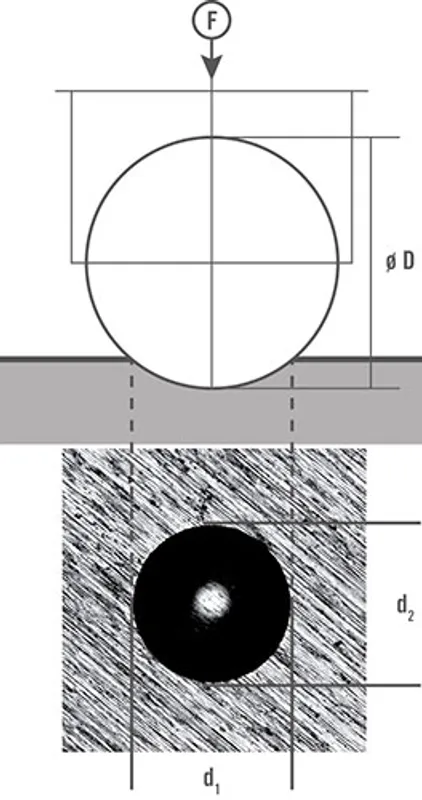
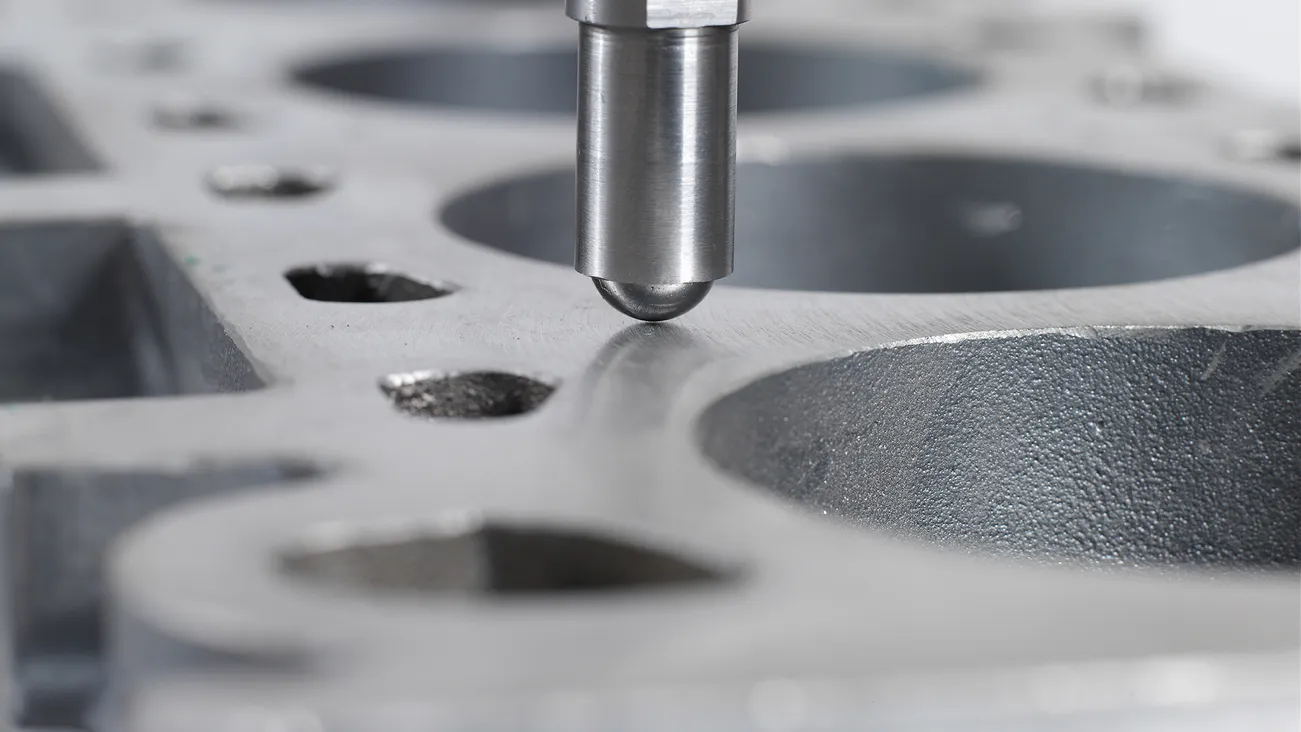
Classification, process, differentiation and practical recommendations.The Brinell hardness test is a globally established and standardized method for determining the hardness of metallic materials. A hard metal ball is pressed into the surface of the workpiece with a defined test force (F). The resulting indentation is then optically measured, and the hardness value (HBW) is calculated from the ratio of test force to indentation area. Due to the large indentation area, the method is particularly suitable for inhomogeneous materials such as cast iron or forgings.
Categorisation of the Brinell hardness test
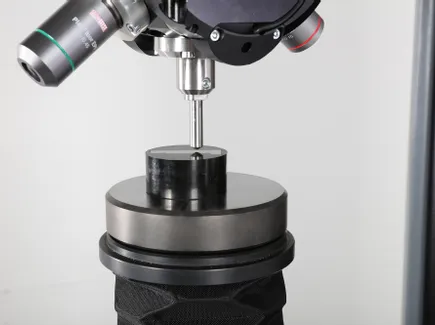
The Brinell hardness test is a method for determining the hardness of materials. It is carried out using a Brinell hardness tester:
-
Standard Compliance: The procedure is internationally standardized according to ISO 6506 and ASTM E10, which guarantees global comparability of hardness values.
-
Versatile Test Load Range: With a load range from 1 to 3,000 kgf, the Brinell method covers both the low-load range and the macro-range (conventional hardness testing).
-
Optical Measuring Principle: As an optical method, the determination of the hardness value is based on the precise measurement of the indentation size left by the indenter in the specimen surface.
-
Precision Indenter: A tungsten carbide ball (HBW) is used. Depending on the selected method, ball diameters of 1 mm, 2.5 mm, 5 mm, or 10 mm are utilized.
Brinell test procedure
The Brinell hardness test is one of the classic optical test methods for determining material hardness. It analyses the size of the permanent impression that a spherical Brinell indenter leaves on the surface of a component. In contrast to the Vickers method, which uses a pyramid-shaped indenter, the Brinell method uses a sphere as the indenter - typically made of hard metal.
The hardness of a material is determined by the ratio between the applied test force and the diameter of the indentation. The larger the indentation left by the Brinell indenter under constant load, the lower the material hardness. This test method is particularly suitable for coarse-grained or soft materials and provides reliable results when assessing mechanical strength.
Calculation of the Brinell hardness
The Brinell hardness (HBW) results from the ratio between the applied test force and the projected indentation area that a Brinell indenter leaves on the material surface. The indentation is determined by the mean value of two perpendicular diagonals, as the shape of the impression is often irregular. In practice, hardness is usually determined using tables or special hardness testing software. To ensure that the impression remains meaningful, the ball diameter and test load must be correctly matched. The load is applied in accordance with the ISO 6506 standard - including an exposure time of 10 to 15 seconds. Comparability of the measurement results is ensured by the application within a defined load level. The Brinell method is particularly suitable for soft to medium-hard materials and provides reliable values for material hardness.
Brinell methods and applications
The Brinell method is a versatile hardness testing method and is suitable for materials with very different degrees of hardness - from soft metals such as aluminium, tin or lead to harder materials such as steel or cast iron.
In order to obtain comparable Brinell hardness values, the test force and ball diameter must be matched to each other within the same degree of stress. This means that the Brinell hardness test can be carried out precisely and in accordance with standards, even with different materials and test parameters.
In practice, the hardness value for the Brinell test is not determined by calculation for each individual measurement. Instead, it is usually determined using tables or corresponding testing software. This displays the hardness value as a function of the average indentation diameter d for all standardised ball diameters and test loads.
The test load must be selected so that the average indentation diameter d lies within the range of 0.24 D to 0.6 D.
In order to reliably maintain this range, the test load and ball diameter must be matched. This results in different degrees of stress - also known as load degrees or load factors - within the Brinell method. The load factor results from the quotient of test force and ball diameter squared (B = 0.102 × F / D²) and remains constant within a load factor. Common degrees of stress are 1, 2.5, 5, 10 and 30. If a material is tested with different ball diameters and forces, this must be done within the same degree of stress in order to ensure comparable results.
| Material Group | Load Factor (Force-diameter index) | Example Methods | Hardness Range (HBW) |
|---|---|---|---|
| Steel, Cast Iron, Iron | 30 | HBW 10/3000, HBW 5/750, HBW 1/30 | 95.5 – 653 |
| Copper & Aluminum Alloys | 10 | HBW 10/1000, HBW 5/250, HBW 2.5/62.5 | 31.8 – 218 |
| Copper, Aluminum (unwrought) | 5 | HBW 10/500, HBW 5/125, HBW 1/5 | 15.9 – 109 |
| Light Metals (soft) | 2.5 | HBW 10/250, HBW 5/62.5, HBW 2.5/15.625 | 7.96 – 54.5 |
| Lead, Tin | 1 | HBW 10/100, HBW 5/25, HBW 1/1 | 3.18 – 21.8 |
The ball diameter must be selected so that the test indentation covers as large a representative zone of the material as possible.
According to ISO 6506, the test load must be applied within a minimum of two to a maximum of eight seconds. The duration of application of the test load is generally 10 to 15 seconds. If the load duration is longer, this must be added to the hardness specification, for example: 210 HBW 5/250/30 (exposure time 30 s).
How to read and represent a Brinell hardness value
A Brinell hardness value consists of the following components:
- The numeric hardness value;
- The three letters "HBW", standing for "Hardness according to Brinell" (with hard metal ball made from tungsten carbide);
- The ball diameter in mm;
- The applied test load in kgf;
- According to ISO 6506: The dwell time of the test load, but only if this is not between 10 and 15 seconds (uncommon in practice)
Example:
210 HBW 5/250/30
- 210 …hardness value
- HBW …as per Brinell with tungsten carbide ball
- 5 …with ball diameter of 5 mm
- 250 …with test load of 250 kgf (or test force of 2.452 kN )
- 30 …dwell time to test force outside recommended duration, in this case: 30 seconds
Specimen requirements for the Brinell method
Normally, the surface of the specimen to be tested must be prepared for Brinell hardness testing, because the surface quality must be good enough to allow correct optical evaluation of the indent.
Compared with the Vickers method, which also tests hardness in the micro range, the surface quality requirements for the Brinell method are nevertheless lower, because the latter normally involves testing with higher loads (in the macro range) and larger indenters (balls), so the surface can be rough.
In detail, the specimen to be measured must meet the following requirements for the Brinell method:
- The specimen must be plane-parallel (clean separation of the specimen from the workpiece required during specimen preparation).
- The specimen to be tested must have a level, metallically bare and smooth surface (grinding and polishing of the specimen surface only necessary for tests with small ball diameters).
- The specimen must be fixed in a rigid mounting fixture, so that is cannot move during the testing process (practical tip: measure with the specimen clamped, or embedded or fixed in a specimen holder).
Advantages and disadvantages of the Brinell method
The Brinell method has the following advantages:
- The Brinell method is ideal for testing inhomogeneous materials such as cast iron, as the large Brinell indenter detects several structural components simultaneously and thus provides a meaningful average value.
- Thanks to the wide selection of ball diameters and test loads, the hardness test can be flexibly adapted to a wide range of materials and applications.
- The comparatively large indentation makes optical measurement easier compared to the fine indentations of other methods such as Vickers.
- Brinell hardness testing also provides reliable results for rough or irregular surfaces - complex surface preparation is often not required.
The Brinell method has the following disadvantages:
- A clean and well-prepared test surface is necessary for precise optical evaluation of the test impression - untreated or heavily contaminated areas can falsify the measurement result.
- With high test loads in the macro range (e.g. HBW 10/3000), there is a risk of plastic deformation or wall formation, which makes evaluation more difficult. Uniform illumination - for example using a ring light - is therefore essential in order to correctly assess the impression.
- The Brinell method is only suitable to a limited extent for very hard materials or particularly thin test specimens, as minimum thicknesses must be observed.
- Compared to faster test methods such as Rockwell, the Brinell hardness test takes longer - including exposure time and optical evaluation, the process can take 30 to 60 seconds or more.